PDK31300-2×6.0+STP CAT6-100KG Elevator Traveling Flat Cable
Elevator Traveling Cables · Industrial Automation
PDK31300
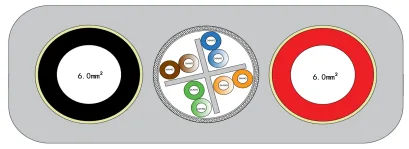
Flat elevator traveling cable with two 6.0mm² power cores plus a shielded CAT6 data group, aramid reinforcement rated 100kg and a PVC jacket.
Product overview
The elevator traveling cable is the moving link between the car and the controller, carrying power, control signals and data as the car travels up and down the hoistway. Unlike a fixed installation, it is bent, stretched and slightly twisted throughout its service life; the section that passes over the traveling guide pulley bends most frequently and is usually the weakest point in the life of the cable. This elevator traveling cable integrates the power cores and a shielded data group in a single flat jacket, so that one run meets both the power and the network data requirement and less hoistway space is taken up by cables laid in parallel.
In projects with a large lifting height, cable self-weight adds to the running acceleration, and round cables tend to kink, twist or rub against the hoistway wall near the pulley. The flat construction is thin in the thickness direction and lies smoothly along the hoistway wall, and the direction of load through the pulley is more stable, which is why it is widely used in high-rise buildings and elevator systems with long travel. Selection for this type of product usually turns not on a single electrical figure but on the balance between structural strength, flexibility and overall dimensions, and this model is designed around that balance.
Construction and materials
The conductor is stranded bare copper with a single wire diameter of 0.2 mm: the power core is 6.0mm², stranded from 191 wires, stranded diameter about 3.18 mm; the data core is 23AWG, stranded from 7 wires of equal diameter, stranded diameter about 0.6 mm. A stranded conductor is more flexible than a solid conductor of the same section and performs better in fatigue under repeated bending, which is one reason traveling cables generally use stranding.
The two types of core are insulated separately. Power cores use PVC insulation with an average thickness of 0.9 mm, minimum point 0.76 mm, insulated diameter 5.0 ± 0.1 mm, in two colour groups, red and black, to distinguish circuits. Data cores use polyethylene insulation with an average thickness of 0.20 mm, minimum point 0.18 mm, insulated diameter 1 ± 0.08 mm; the four pairs are coloured green/green-white, brown/brown-white, orange/orange-white and blue/blue-white for identification and termination on site. The division of work between the two materials is clear: PVC processes well and has higher mechanical strength, which suits the larger power cores, while polyethylene has lower dielectric loss and is used for the data cores, where signal fidelity matters more. The data group has a shield of aluminium foil plus tinned copper braid to suppress interference from variable-frequency equipment in the hoistway; braid coverage can be over 70 per cent, balancing shield continuity against cable flexibility.
The load-bearing structure is the focus of this model. An aramid fibre braid reinforcement is built into the jacket and the cable is designed for a 100KG load capacity; tensile load during travel is carried mainly by the reinforcement, so the copper conductors are not loaded directly and do not break or elongate. The outer jacket is PVC, grey, with a finished section of 19.4 ± 1.5 mm × 7.4 ± 0.5 mm (width × thickness). Evenness of jacket thickness directly affects abrasion and tear performance, so the minimum point is measured after extrusion to ensure jacket thickness at the two edges of the flat cable.
Key features
- Flat integrated construction: power and data in one cable, small in the thickness direction, suited to wall-hugging installation in the hoistway.
- Built-in aramid fibre braid reinforcement carries the tensile load during travel and accommodates the self-weight of long travel.
- Small bending radius; runs over pulleys with repeated bending for long periods without kinking or twisting near the pulley.
- The rated voltage covers both the car power circuit and the control circuit, so one run meets the supply needs of several circuits.
- The operating temperature range suits the wide summer-to-winter spread in the hoistway and the cable stays flexible at low temperature.
- The data group uses aluminium foil plus tinned copper braid shielding, reducing the effect of interference on signal transmission.
- Jacket material and flame-retardant grade can be customised to project needs; a low-smoke zero-halogen jacket can be produced after confirmation with the manufacturer.
Electrical performance
At a reference temperature of 20 °C the maximum conductor DC resistance is 3.1 Ω/km for the power cores and 89.2 Ω/km for the data cores. DC resistance reflects whether the copper content and cross-section meet specification and is the main basis for judging heating and voltage drop; for a traveling cable that is continuously flexing, stability of conductor resistance also affects operating reliability and heating.
The rated voltage is 450/750V, covering both the car power and the control circuit. The long-term permissible operating temperature is -20 °C to +80 °C: the low end covers winter conditions in the hoistway, the high end leaves margin for the temperature rise in hoistway and machine room in summer, and the site temperature should be confirmed to fall within this range at selection. The minimum bending radius is 25D, where D is the cable diameter; this figure governs installation and operation at the traveling pulleys and at the bends under the car, and forced bending below it should be avoided on site.
The data group carries network data and control signals; its construction and electrical figures follow the relevant requirements for Category 6 network cable and meet common surveillance, communication and network access needs. Insulation and jacket thickness and minimum points are controlled to the product specification, and continuity, insulation resistance and withstand voltage are routine tests before delivery; specific test voltages and items follow the technical requirements confirmed on the order. The reference standard is GB/T 5023, with supplementary provisions per the technical agreement supplied by the user.
Typical applications
This model suits elevator systems that need power and network data in the same traveling cable, for example projects where car lighting, door operator power and monitoring, communication or network signals enter through one channel. The flat construction with reduced thickness suits hoistways where space is limited and only a small gap can be left between car and hoistway wall; the shielded data group suits hoistways with many variable-frequency drives and a comparatively complex electromagnetic environment.
In elevators with large lifting height and long travel, the dynamic loads from cable self-weight and running speed are more pronounced and the reinforcement must have sufficient load capacity and fatigue resistance; the reinforcement of this model is configured to its design load grade and covers this requirement. Beyond elevators, flat moving cables of similar construction can be used on cranes and overhead travelling equipment with reciprocating power supply needs; suitability depends mainly on bending radius, running speed and installation method. Where the duty calls for additional flame retardance, low smoke zero halogen or oil resistance, this can be requested at order and met by changing the jacket material.
Customisation and selection
Beyond the standard combination of power cores plus one shielded Category 6 data line, the power core section and count, the number of data groups and whether to include optical fibre can all be adjusted on the same construction platform. Cable length, print marking, jacket colour and jacket material (for example flame-retardant PVC or LSZH compound) can also be customised to project requirements. At selection it helps to provide: travel and lifting height, maximum running speed, pulley diameter and expected number of bends, the number of circuits to be carried and their cross-sections, whether a network or fibre channel is needed, and the temperature range in the hoistway. With these, a better balance of flexibility, overall dimensions and load capacity can be found.
The parameters listed here are the standard specification of this model; actual delivery follows the technical agreement confirmed on the order and the factory test data. Before use outside the standard temperature, speed or bending ranges, confirm with the manufacturer and, where necessary, provide samples for verification.
Related in Elevator Traveling Cables

Engineering enquiry