Watertight Cable 5x18AWG, Bare Copper, PVC Insulation, TPU Sheath, 7.6 mm
Watertight Optoelectric Cables · Marine & Subsea
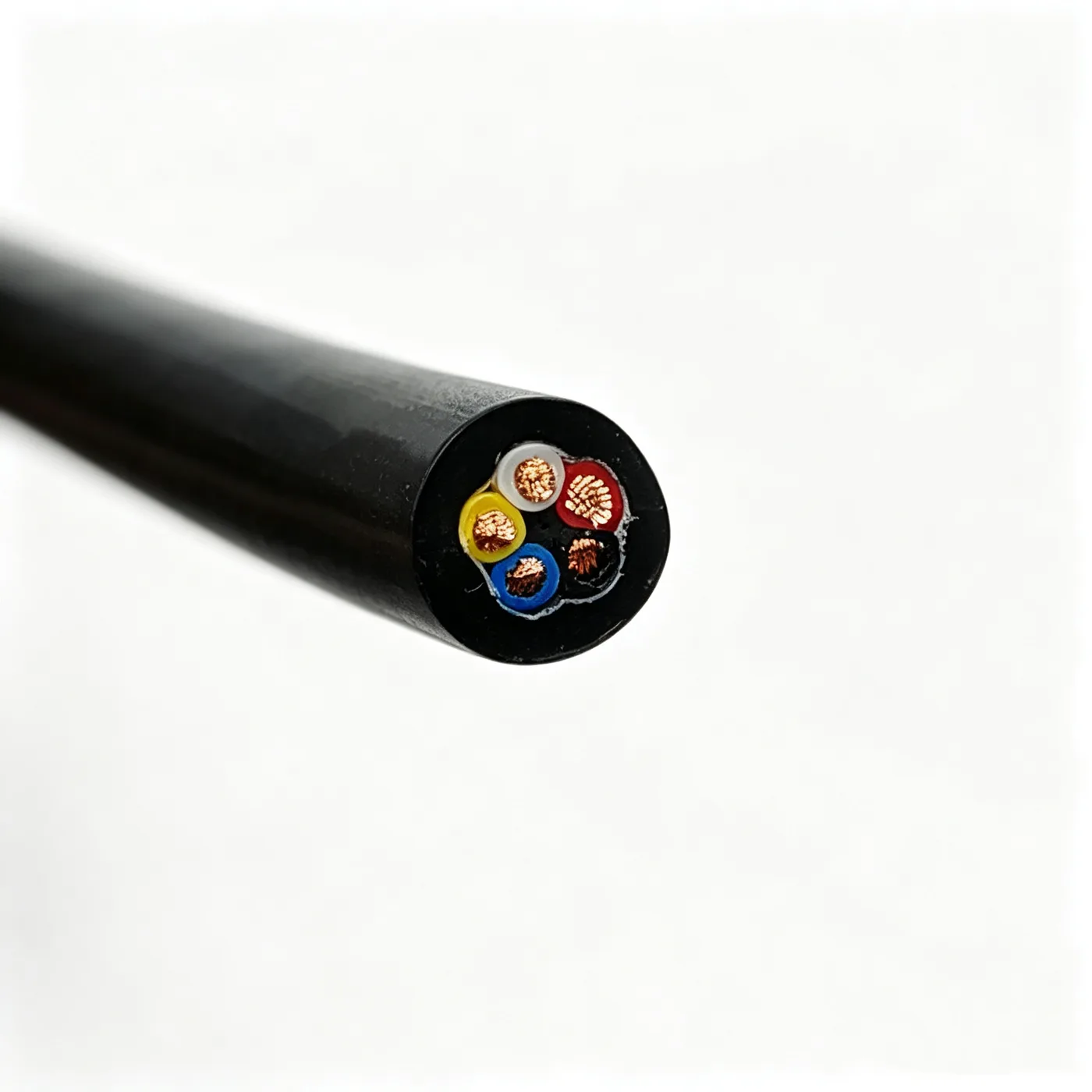
Watertight cable 5x18AWG
Five-core watertight cable, 18AWG bare copper, 0.36 mm PVC insulation, PVC filler and non-woven wrap, black matt TPU sheath, 7.6 mm diameter.
Product overview
This multicore version of the watertight cable is one of the basic constructions in the PAIDE Cable watertight optoelectric hybrid cable range for power and signal transmission. Several power cores of the same specification are cabled together, the gaps are rounded out with filler strips, and a polyether polyurethane sheath is extruded over the assembly in one pass. The design intent is not simply to cover the conductor: each layer has a defined role — the insulation isolates, the filler eliminates internal voids, the wrap stabilises the core, and the sheath excludes water and mechanical damage. Only together do they maintain stable insulation resistance underwater over the long term.
Construction and materials
- Conductor: bare copper, multi-strand, 18AWG
- Conductor diameter: 1.17 mm
- Insulation: PVC, thickness 0.36 mm, insulation diameter 1.9 mm
- Core colours: yellow, blue, black, red, white, arranged in a fixed order during cabling for matching at both ends
- Cabling: cores cabled in the same direction, cabled diameter 5.2 mm
- Filling: core gaps rounded out with PVC filler strips, bound with a non-woven tape
- Outer sheath: TPU, thickness 1.2 mm, matt black
- Finished outer diameter: 7.6 ± 0.15 mm
The conductor is a multi-strand bare copper construction with fine wires and a high strand count, keeping the cable flexible for routing in tight equipment spaces while maintaining the conductive cross-section. The insulation is polyvinyl chloride, balancing dielectric strength, flexibility and processing stability; cores are colour-coded and arranged in a fixed order during cabling, so field wiring does not rely on temporary marking.
The roundness of the core directly determines whether the sheath can be applied evenly. After cabling, PVC filler strips fill and round out the gaps between the cores, and a non-woven tape binds the assembly so that the core stays stable during subsequent extrusion, deployment and bending without separating. The outermost layer is a polyether polyurethane sheath, a material with low water absorption and good hydrolysis resistance, together with good abrasion and tear resistance — suitable where the cable is repeatedly deployed and rubs against equipment housings or decks. The sheath surface is matt finished to reduce sticking and glare during handling.
How the watertight construction works
Watertight performance is normally ensured by several layers together; a single material layer can rarely achieve it alone. First is the continuity of the insulation: as long as the insulation does not crack or delaminate under bending and pressure, water cannot reach the conductor directly. Second is the density of the core filling: if voids remain between the cores, water can form a longitudinal path along them, so rounding out with filler strips and binding with tape are essential steps. Third is the integrity of the sheath: it must fit tightly against the core with no internal voids, be extruded to a uniform wall thickness, and be sealed at the ends and joints. If any one of these is missing, water will enter at the weakest point.
Sharp bends and excessive tension should also be avoided in use. Once the sheath is scratched or cracked, water will penetrate inwards from the damaged point, so periodic inspection of the end seals and of the sheath appearance is standard practice for maintaining watertight performance.
Key features
- Multi-strand conductor with soft insulation: the cable is flexible, suited to tight spaces and mobile routing
- Filler strips and binding tape: the core stays round and stable, and the cores do not shift when bent
- Polyether polyurethane sheath: hydrolysis, abrasion and tear resistant, suited to long-term immersion and repeated deployment
- Multi-colour coding: clear identification at termination, reducing misconnection on site
- Clear layer structure: core count, cross-section and sheath colour can be adapted per project
Electrical and mechanical performance
Rated voltage, long-term operating temperature range, minimum bend radius and permissible pulling force depend on the specific environment and installation method. This specification does not state blanket values; actual values are subject to the specification document confirmed by both parties.
Structurally, the multi-strand bare copper conductor provides low DC resistance and a good current margin; the polyvinyl chloride insulation provides stable insulation resistance and withstand voltage; the polyether polyurethane sheath remains intact in wet and abrasive environments, which is the basis for long service on deployment equipment. Control of the finished outer diameter requires a balance between uniform sheath wall thickness and installation space, and the actual dimensional tolerances likewise follow the confirmed specification document.
Typical applications
- Power and signal connections for underwater vehicle bodies, thrusters and accessories
- Power cables for underwater observation equipment, lighting and camera units
- Connections repeatedly deployed between underwater and deck positions on marine engineering equipment
- Temporary or fixed wiring for tank testing and underwater inspection equipment
- Applications requiring multicore power and control signal transmission with flexibility
Installation notes
Route the cable with an adequate bend radius and avoid sharp angles near the end terminations; prevent the cable from being crushed, stepped on or cut by equipment edges during deployment. End termination should be carried out by personnel with subsea cable experience: seals must fit tightly against the sheath, joints must not carry tensile load, and the load should be taken by a dedicated structure. For cables kept permanently immersed, inspect the sheath periodically for cracks, blisters or discolouration and replace it promptly if found, so that moisture-damaged insulation does not take the whole line out of service.
Selection and customisation notes
Variants available in the same series include: adjustment of core count and cross-section, inclusion of optical fibre or data cores, choice of sheath colour and surface finish, addition of a braided reinforcing layer or strength members, and the type of end termination. All of these can be customised per project, with the specific construction and parameters subject to the specification document confirmed by both parties.
When selecting, clarify three conditions first: operating depth and duration of continuous immersion, deployment method and acceptable minimum bend radius, and the number of power and signal channels to be carried at the same time. Once these are clear, determine core count, cross-section and sheath material — this avoids paying for unnecessary redundancy and avoids rework caused by an inadequate construction. If the operating environment involves oil contamination, chemical media or strong vibration, state this at the selection stage so that the sheath material and outer protection can be specified accordingly.
Related in Watertight Optoelectric Cables
 4×2×24AWG (UTP) + 2×14AWG + 2×12AWG
 Custom
 Longitudinally watertight cable 2×22AWG+STPCAT6-100KG
 PDK81301
Engineering enquiry