Watertight Optoelectric Cable 4×2×24AWG (UTP) + 2×14AWG + 2×12AWG
Watertight Optoelectric Cables · Marine & Subsea
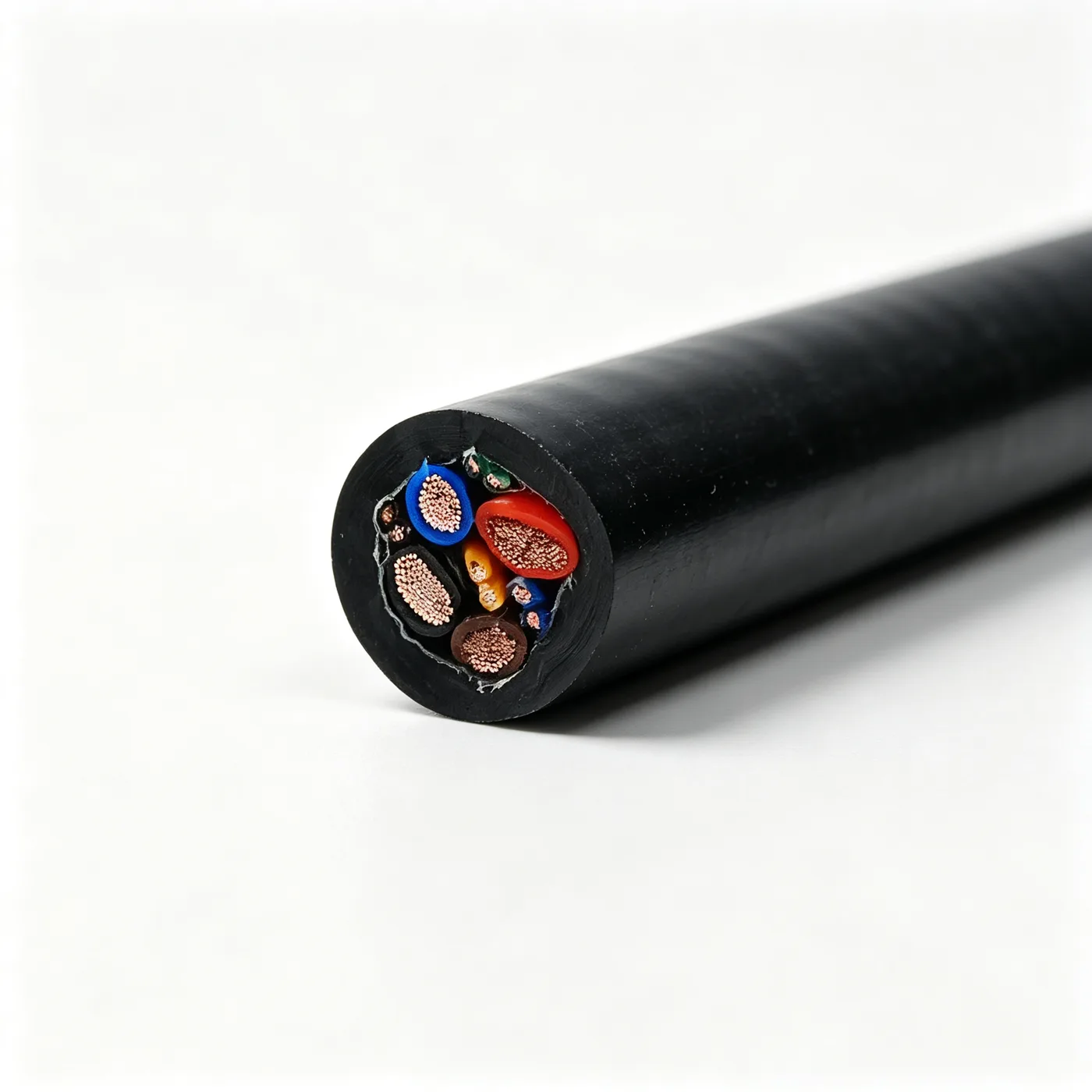
4×2×24AWG (UTP) + 2×14AWG + 2×12AWG
Watertight combined power and data cable with 4 × 2 × 24AWG UTP pairs, 2 × 14AWG and 2 × 12AWG power cores, 11.8 mm black TPU sheath.
Product overview and positioning
Underwater power and communication often have to be carried by a single cable, and this watertight cable is built as a combined power and data construction for exactly that duty: two power core sizes for supply, plus four unshielded twisted pairs for data and signals. The cable is assembled by stranding, filling of the interstices, tape wrapping and extrusion of the outer sheath, and is intended for permanently damp conditions with possible water immersion.
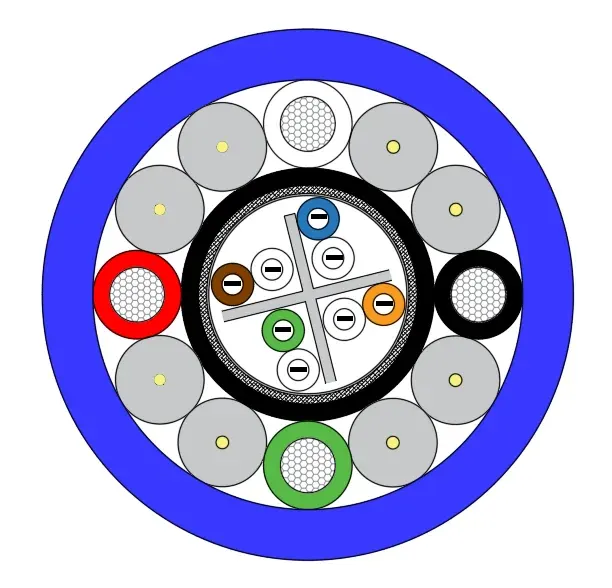
The cable can be understood in four levels: power cores, data units, cabling with fillers, and outer sheath. The power section has two core groups that supply the equipment; the data section has four unshielded twisted pairs that carry control signals and data. Both types of unit are stranded together, so one cable performs the supply and communication duties that would otherwise need two, cutting the number of runs, the number of joints and the overall weight; the compact construction is also easier to route on space-restricted underwater equipment.
Conductor
The power cores come in two sizes, both with bare copper strand conductors laid in a left-hand direction. The 14AWG core uses a multi-strand conductor with a nominal cross-section of 2.08 mm² and a stranded diameter of about 1.87 mm; the 12AWG core is also multi-strand, with a nominal cross-section of 3.31 mm² and a stranded diameter of about 2.36 mm. The lay balances current-carrying capacity against flexibility: a tighter lay gives a more flexible core but raises the difficulty and cost of stranding, so each of the two sizes uses the lay best suited to its own current requirement.
Insulation
Both power core sizes are insulated with extruded PE. The larger size has an insulated core diameter of 3.3 mm and is identified in red and black; the smaller size has an insulated core diameter of 2.8 mm and is identified in brown and blue. Insulation thickness is the same for both at 0.47 mm. PE has low dielectric loss and stable insulation resistance, is a common insulation for power cores and helps keep insulation performance stable in damp conditions; the two sizes are colour-coded within the same cable to make termination and circuit checking easier.
Data units
The data section consists of four twisted pairs, each made of two copper strands of 0.2 mm nominal diameter, stranded, equivalent to 24AWG. The pairs are coloured orange/orange-white, blue/blue-white, green/green-white and brown/brown-white in a UTP unshielded arrangement. Twisting uses the symmetry of the two conductors to cancel part of the external interference, carrying control and monitoring signals within a limited space. Where the site electromagnetic environment is more complex or signal integrity requirements are higher, an additional shield over the data units and an adjusted pair lay can be discussed with the supplier as a custom option.
Cabling and fillers
The four data units and the two power core groups are stranded together in a left-hand direction to a cable core diameter of 8.6 ± 0.5 mm. Transparent PP filler rods fill the interstices so that the core section stays round and the units share load evenly, preventing cores from pressing against each other and deforming during handling and repeated bending. Non-woven tape is wrapped over the core to hold its shape and to act as a separator and cushion when the outer sheath is extruded.
Outer sheath
The outer sheath is black TPU, applied by extrusion to a thickness of 1.7 mm for a finished diameter of 11.8 ± 0.3 mm. TPU combines good flexibility with abrasion and hydrolysis resistance; the sheath is extruded as one piece with no longitudinal seam, and together with the filled interstices and tape wrap it slows the path for water travelling along the cable. The specific water-pressure rating and permissible immersion depth depend on the operating depth, the handling method and the connector sealing arrangement, and are subject to the specification document confirmed by both parties.
Key features
- Power and signal in one cable: two power core sizes and four data pairs are cabled together, so a single run meets both supply and communication needs.
- Round construction, even load: transparent PP fillers fill the core interstices, keeping the section stable so that cores do not shift during handling and bending.
- Integrally formed sheath: the black extruded TPU sheath has no longitudinal seam, resists abrasion and hydrolysis, and suits damp and immersed conditions.
- Convenient for mating hardware: a stable finished diameter makes it easier to select watertight connectors, seals and handling gear.
- Adaptable construction: shielding of the data units, sheath material and colour, core colours and length can all be agreed to project requirements.
Electrical and mechanical performance
Electrically, the power cores use bare copper stranded conductors with PE insulation, while the data section uses four UTP pairs. Rated voltage, insulation resistance, voltage withstand test and other electrical values depend on the application and are confirmed between the parties; this cable is not offered against fixed figures. Mechanically, the core diameter, finished diameter, sheath thickness and the stranding of conductors and core together determine flexibility, tensile behaviour and resistance to compression. Where handling loads are high or bending is very frequent, tensile elements can be added to the core, the stranding and cabling adjusted, or the sheath thickened; the specific arrangement is subject to the specification document confirmed by both parties.
Typical applications
- Power supply and data return for underwater observation equipment and sensor networks;
- Combined power and signal transmission for underwater robots, ROVs and similar equipment;
- Immersion-rated wiring in marine engineering, water conservancy and aquaculture;
- Combined power and communication wiring on vessels, at quays and in permanently damp environments;
- Subsea or shore-side equipment connections where fewer cable runs and simpler joints are required.
Selection and customisation notes
Three points are worth establishing before selection. First, the power and current demand of the equipment, which determines whether the two power core sizes need adjusting. Second, the data rate and interference requirements, which indicate whether shielding should be added over the twisted pairs. Third, the operating depth and handling method, which confirm the sheath material, the sealing arrangement and whether tensile reinforcement is needed. For installations with tight space or frequent handling, optimising the lay and fillers on the current construction is the preferred route to greater flexibility; for fixed installations, the sheath and tensile structure can be strengthened instead. These adjustments are agreed per project, and the final specification and performance figures are subject to the specification document confirmed by both parties.
We welcome further discussion with PAIDE Cables on the construction, materials and mating hardware for watertight power and data composite cables, and will provide selection and customisation advice to suit the actual operating conditions.
Related in Watertight Optoelectric Cables
Engineering enquiry