Spring Cable 7×18AWG Coiled TPU 8.6mm
Spiral & Spring Cables · Industrial Automation
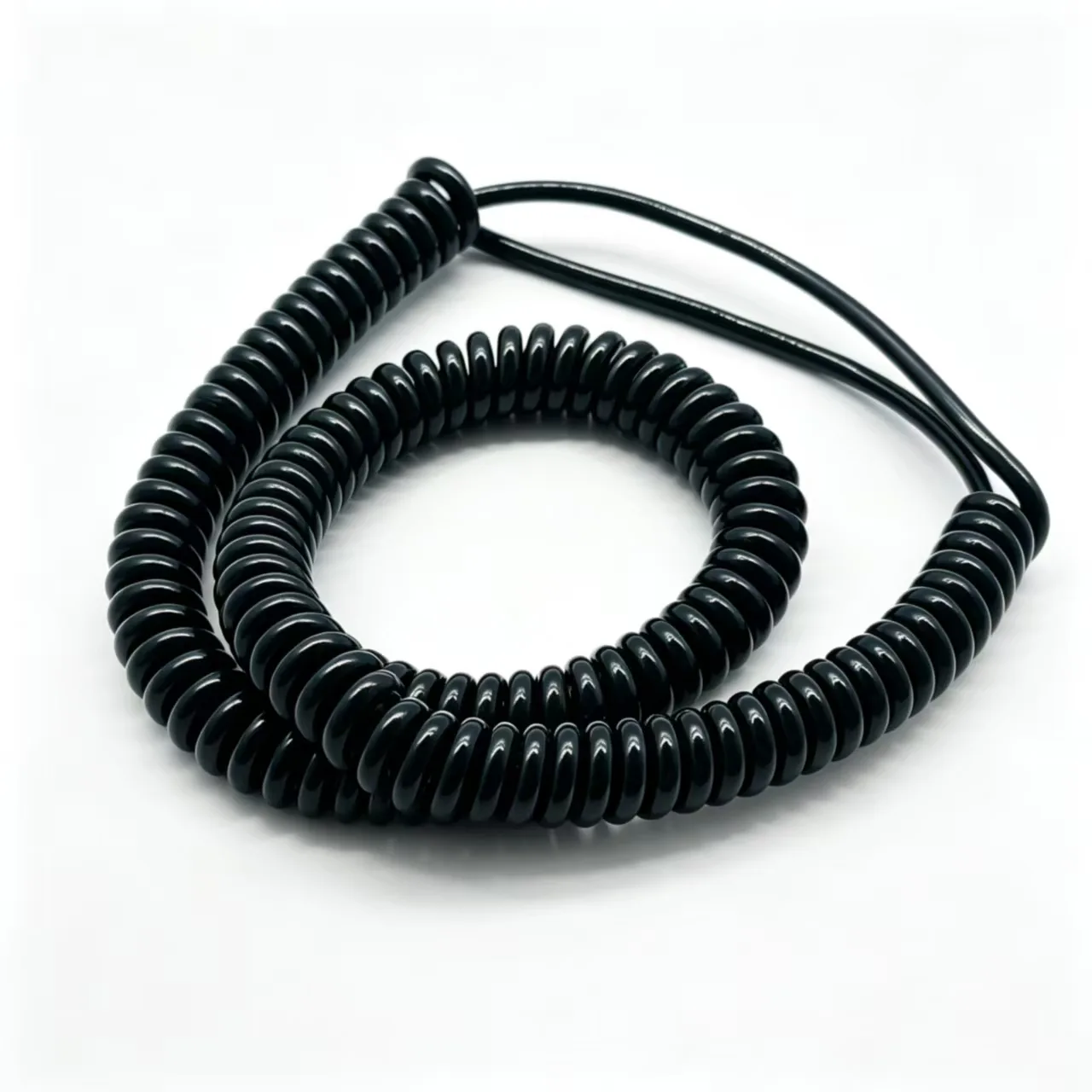
Spring cable 7×18AWG
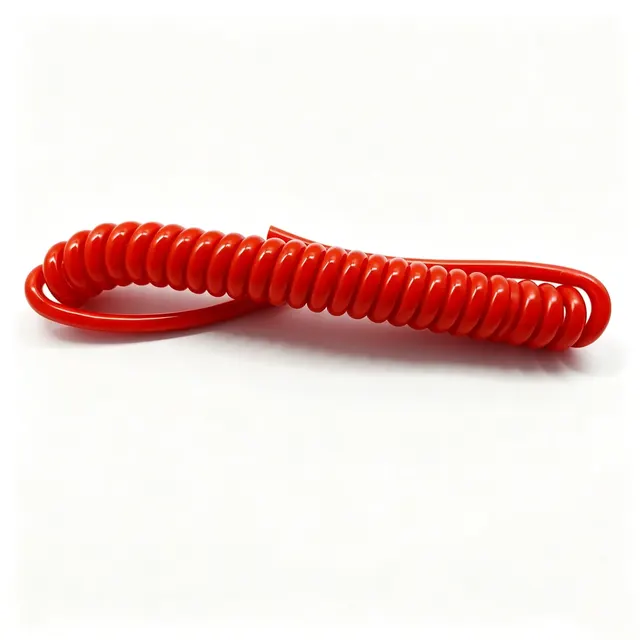
Seven-core 18AWG spiral cable with bare copper conductors, 0.4mm PP insulation and 1.3mm black TPU jacket, 8.6±0.2mm OD, formed coil with straight ends.
Product overview
A spring cable, also called a spiral cable, is a special cable in which a finished multi-core cable is coiled into a helix to suit the application. The cable stays compact at rest, extends along its axis when pulled, and returns to its original coiled shape by its own resilience when the load is released. This form suits electrical connections whose length must change with the travel of the equipment: as the equipment moves within its working stroke, surplus cable does not trail on the floor and no separate take-up device is needed.
Compared with cable laid in a straight line, a spring cable works in repeated extension and retraction, so the flexibility of the conductor and the flex endurance of the insulation and jacket matter more. Our spring cables are based on a multi-core cabled construction, with conductor, insulation and jacket materials selected for the environment; the coil section and the straight ends are formed continuously on the same finished cable without joints, which simplifies installation and fixing.
Construction and materials
This size is a seven-core construction, 7×18AWG. Seven cores are cabled in the specified order and the jacket is extruded over the assembly; from the inside out:
- Conductor: stranded bare copper wire
- Insulation: PP, 0.4mm thick; core colours red, orange, green, blue, brown, black, white
- Cabling: cores laid up in the specified order and wrapped with non-woven tape, cabled diameter 6±0.5mm
- Outer jacket: TPU, 1.3mm thick, black
- Finished outer diameter: 8.6±0.2mm
The conductor is stranded from multiple bare copper wires in the same direction, with fine wire and a high strand count, so the assembly is soft: wires can slide against each other when bent and the internal stress is low. The insulation is extruded PP over each conductor, providing both electrical insulation between cores and mechanical support for the core; the seven cores are colour coded so circuits can be identified without measuring.
In cabling, the seven insulated cores are laid up in order and wrapped with non-woven tape. The tape stabilises the cabled structure and cushions the cores against each other, so they do not shift during repeated extension, and it also makes the subsequent jacket thickness more even. The outermost TPU jacket is black and tightly extruded; it provides abrasion and oil resistance and keeps out external media, and is the layer that mainly determines the service life of a spring cable.
The coil is wound and set at the finished-product forming stage, and each straight end is left with installation and termination length; the required end form and connector configuration can be set to match the equipment.
Key characteristics
- Coil and straight ends formed in one piece; the cable extends along its axis and takes little space when retracted
- The cable does not trail or tangle during deployment, so wiring on moving parts stays tidy
- TPU jacket resists abrasion, oil and low temperature, suiting frequent reciprocating flexing
- Seven colour-coded cores make termination and maintenance straightforward
- Non-woven tape stabilises the cabled structure and keeps cores from shifting in service
- Stranded bare copper conductor is flexible and keeps conductivity continuous after bending
- Spring forming: customisable
- Straight sections or connectors can be provided at both ends to project requirements
Besides structural flexibility, the advantage of a spring cable lies in the installation method. Where a conventional cable is used between a moving part and a fixed end, a drag chain, pulley or take-up is usually needed; with a spiral cable the cable itself provides the change in length, the connection is simplified and the risk of interference at the moving part is reduced.
Electrical and mechanical performance
- Rated voltage: selected to project requirements, subject to the specification document confirmed by both parties
- Temperature rating: determined by the insulation and jacket materials selected, subject to the same specification document
- Tensile capacity: varies with construction and strength member configuration, customisable per project
- Flex life and retraction behaviour: related to coil diameter, cable diameter and jacket material, to be selected for the actual duty
Each of the seven cores is individually insulated, the electrical insulation between cores being provided by the extruded layer, and the jacket is extruded over the complete assembly to give full mechanical protection. The conductor is stranded bare copper, and under reciprocating flexing the stranded construction distributes bending stress so the conductor stays continuous in long service. Mechanically, the jacket resists external abrasion and scuffing while the tape and cabled structure hold the cores in position; together they determine the number of flex cycles and the retraction capability of the cable.
Where signal integrity matters, a shield can be added around the cores; where higher pulling loads must be carried, a strength member can be added and arranged separately in the construction so that the load does not act on the conductors.
Typical applications
- Portable test instruments and hand-held equipment that must be pulled out and retracted repeatedly
- Power and signal connections on hand-held power tools and cleaning equipment moving along a fixed path
- Electrical connections at moving parts of automated equipment, replacing loose wiring that tends to tangle
- Applications where the cable must be coiled for storage, transport or temporary installation
- Internal wiring between fixed and moving ends where travel is limited
In these applications the spiral cable provides the electrical and signal link between the moving and fixed ends and must both connect reliably and avoid restricting the movement range of the equipment. Selection should start from the actual travel, daily flex cycles and installation space, then fix the construction and materials.
Selection and customisation notes
When choosing a spring cable, clarify the following before fixing the specification:
- Working travel length and maximum extension required
- Equipment speed, number of cycles per day and expected service life
- Installation space, fixing method and termination at both ends
- Ambient temperature, oil, moisture and UV exposure
- Whether shielding, tensile capability or other additional functions are needed
Conductor cross-section, core count, insulation and jacket materials can all be adjusted per project; for tensile duty, high abrasion or outdoor use, strength members can be added or a more suitable jacket material used. The division of length between the coil and the straight ends, whether installation lengths should be reserved, and the connector types and wiring at both ends should all be stated when the specification is confirmed, to avoid tension or insufficient length after installation.
The parameters on this page are general construction parameters, given to describe the construction and process characteristics of this product type; the delivered specification, performance figures and acceptance requirements are subject to the specification document confirmed by both parties.
Related in Spiral & Spring Cables
Engineering enquiry