PDK71902-7x1.5 Spring Cable - 41 mm Coil, 1600 mm Rest Length, PUR Sheath
Spiral & Spring Cables · Industrial Automation
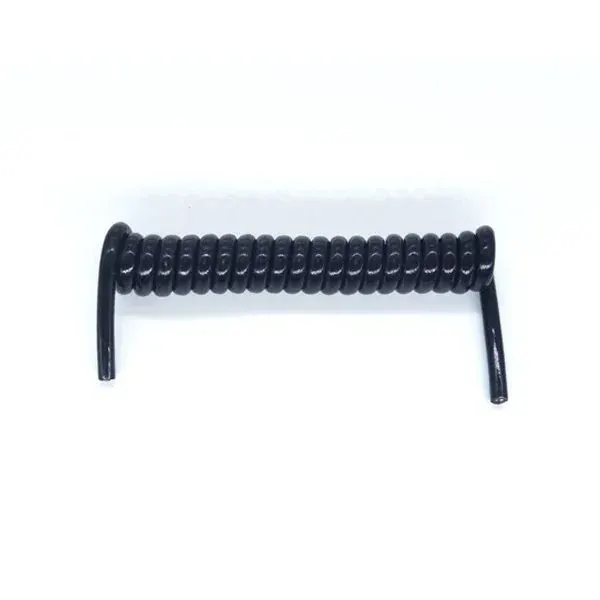
PDK71902
Spring cable, 7x1.5 mm2 bare copper cores, PE insulation, PUR sheath, 11.1 mm OD, 41 mm coil diameter, 1600 mm rest length, rated 300/500 V.
Product overview
PDK71902-7x1.5 is a spring (spiral) cable developed by PAIDE Cable for moving connections on industrial equipment. Several insulated cores are cabled, sheathed and then coiled and set into a freely extendable helix, with straight sections left at both ends for fixing and connection. Where equipment moves back and forth and a short continuous take-up is needed, a fixed-length cable often fails early through repeated bending; a spring cable stores the spare length in the coil, so the cable stays in a controlled elastic extension during use, reducing the risk of dragging on the floor, tangling or being hooked by moving parts, and saving routing space inside and around the equipment.
The product is positioned as a general industrial retractable connection cable for medium and short travel with low to medium operating frequency. The finished cable consists of conductor, insulation, cabled core and outer sheath, with a material system built mainly on bare copper, polyethylene insulation and a polyurethane sheath, balancing conductivity, insulation reliability and sheath abrasion and oil resistance.
Construction and materials
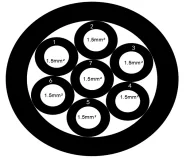
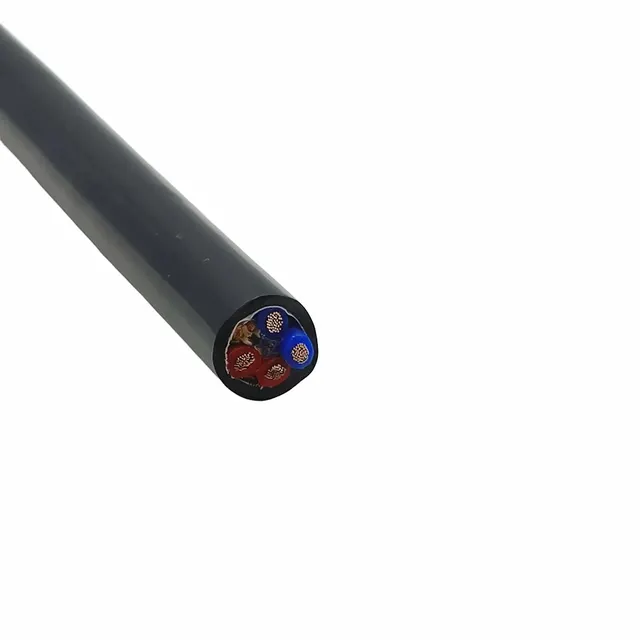
The conductor is a stranded bare copper construction; each core is multi-strand with a stranded diameter of 1.59 mm, stranded evenly to keep it supple in bending. The insulation is PE (polyethylene) with an average thickness of 0.56 mm, a minimum thickness of 0.47 mm and an insulation diameter of 2.7 ±0.05 mm; concentricity is good, which helps keep the cross-section round after cabling. The product has seven cores with a cross-section of 1.5 mm2 each; the cores are identified by number, marked 1 to 7 in black, for core-by-core identification during wiring.
After cabling, the outer sheath is extruded. The sheath material is PUR (polyurethane), black, with an average thickness of 1.5 mm, a minimum thickness of 1.3 mm and a finished outer diameter of 11.1 ±0.3 mm. PUR sheaths are abrasion-resistant, oil-resistant, tear-resistant and have good resilience, which is exactly the property a spring cable relies on for repeated extension. Sheath thickness is controlled by both average and minimum values, avoiding locally thin sheath after coiling that could compromise insulation.
Helix and geometric parameters
Besides the usual cross-section parameters, a spring cable requires attention to the geometry after helix forming, since these dimensions determine the installation space and the available travel. The helix parameters of this model are as follows:
- Coil diameter 41 ±4 mm
- Rest length 1600 ±20 mm
- Straight section at both ends 500 mm each
- Number of coils 148 ±4
- Minimum bending radius 15D (D = cable diameter)
- Rated temperature -30 C to +105 C
The coil diameter determines the outline and installation space of the helix; the rest length and the number of coils together determine how densely the coils are packed; the straight sections at both ends are the flat parts left for fixed installation and connection. In practice, the travel (extension), the straight path length required after extension and the operating frequency usually decide whether a specification is suitable more than the cross-section parameters do, so it is advisable to calculate from the actual installation before confirming.
Key features
- High flexibility: fine-strand bunched conductors with flexible insulation and sheath give the cable low overall stiffness, suitable for small bending radii.
- Repeated extension: once formed into a helix, the cable is stretched and retracted with the load shared along the whole coil, so the number of bending cycles at any single point is markedly lower than with a fixed-length straight cable.
- Abrasion and oil resistance: the PUR outer sheath withstands mechanical wear and oily environments, which suits use inside equipment and on industrial sites.
- Wide temperature range: covers continuous operation of most indoor and outdoor equipment at normal temperatures; applications outside this range require separate assessment.
- Stable structure: insulation thickness is controlled by both average and minimum values, the cabled cross-section is round, and local bulging or collapse after coiling is unlikely.
Electrical performance
The rated voltage of this model is 300/500 V and the maximum conductor DC resistance at 20 C is 13.5 Ω/km. These values can be used to estimate line voltage drop: where several cores work at the same time, or the run is long or the load heavy, the conductor cross-section should be checked against the current demand and the permitted voltage drop, and a larger cross-section from the same series used if necessary.
Where interference must be suppressed, the construction and shielding can be adjusted as required, for example by adding an aluminium foil plus tinned copper braid composite shield, an inner sheath or twisted pairing; the actual arrangement depends on the application. All electrical parameters are subject to the final confirmed specification.
Other specifications in the series
Spring cables are graded by finished outer diameter, coil diameter and resistance. Besides this model, PAIDE Cable offers several standard constructions in the same series for selection by space and current-carrying requirement. The conductor DC resistances of the standard specifications below are given under the same test conditions as above:
- PDK11303-6x0.3: six cores, PE insulation, matt PUR sheath, with PE rod and cotton yarn fillers, finished outer diameter 6.3 ±0.3 mm, coil diameter 22.6 ±2.0 mm, rest length 270 ±20 mm, maximum conductor DC resistance 61.7 Ω/km, minimum bending radius 40 mm.
- PDK11303-4x2.5: four cores, PP insulation, PUR sheath, finished outer diameter 11.5 ±0.3 mm, coil diameter 50 ±2 mm, rest length 1050 ±10 mm, rated voltage 450/750 V, maximum conductor DC resistance 7.5 Ω/km.
- PDK11301-1x0.16: single core, PE insulation, PUR sheath, finished outer diameter 2.5 ±0.3 mm, coil diameter 10 ±2 mm, rest length 460 ±30 mm, 176 coils, maximum conductor DC resistance 111 Ω/km.
- PDK11303-4x28AWG+28AWG coaxial: four cores plus coaxial composite, aluminium foil plus tinned copper braid shield, TPU inner and outer sheaths, finished outer diameter 4.5 ±0.3 mm, coil diameter 17 ±2.0 mm, rest length 240 ±20 mm, rated voltage 300/300 V, maximum conductor DC resistance 215 Ω/km, minimum bending radius 27 mm.
PDK11303-6x0.3 and PDK11301-1x0.16 share the voltage class of this model, and all the standard specifications above have the same rated temperature as this model. When selecting, first fix the outer diameter and coil diameter from the installation space, then match the conductor cross-section to the current-carrying and voltage drop requirements.
Typical applications
- Connections between moving parts and fixed cabinets in industrial automation equipment, such as internal wiring for slides, telescopic mechanisms and tilting mechanisms.
- Retractable connection between hand-held pendants, control boxes and the host unit, short when stowed and covering the working range when extended.
- Short elastic connections between sensors, test instruments and display terminals, reducing the chance of the cable being pulled.
- Internal wiring for movable control panels, doors and sliding parts of cabinets, preventing the cable from being pinched or entangled when doors are opened and closed.
- Exterior connections where a neat appearance and compact routing are required; the helical form itself helps to organize the cable.
Customization and ordering notes
Spring cables are customized to the application: core count, conductor cross-section, insulation and sheath materials, color, helix outer diameter, number of coils, rest length, straight section length and end preparation (whether connectors are fitted, whether the ends are stripped and tinned) can all be agreed. We recommend confirming in the following order:
- First determine the extension travel and installation space, and select the coil diameter, rest length and straight section length accordingly.
- Then determine the conductor cross-section and core count from the current-carrying and voltage drop requirements, leaving margin where several cores work at the same time.
- Then confirm the temperature, oil, wear and bending frequency of the environment, and select the sheath material and shield type accordingly.
- Finally confirm the termination at both ends and the appearance requirements (color, marking), and request the corresponding specification to check the parameters.
Where the operating conditions are not yet clear, please provide travel, installation dimensions and electrical requirements first, and PAIDE Cable will propose a construction and samples as needed; parameters are subject to the final confirmed specification.
About PAIDE Cable
PAIDE Cable has long been engaged in the development and manufacture of special cables, covering drag chain and high-flex moving cables, spring and spiral cables, subsea and watertight cables, buoyant and zero-buoyancy cables, drum and crane cables, cables for robots and pipeline and downhole work, and elevator and flat cables. Structural design and custom production can be provided to suit equipment conditions.
Related in Spiral & Spring Cables
Engineering enquiry