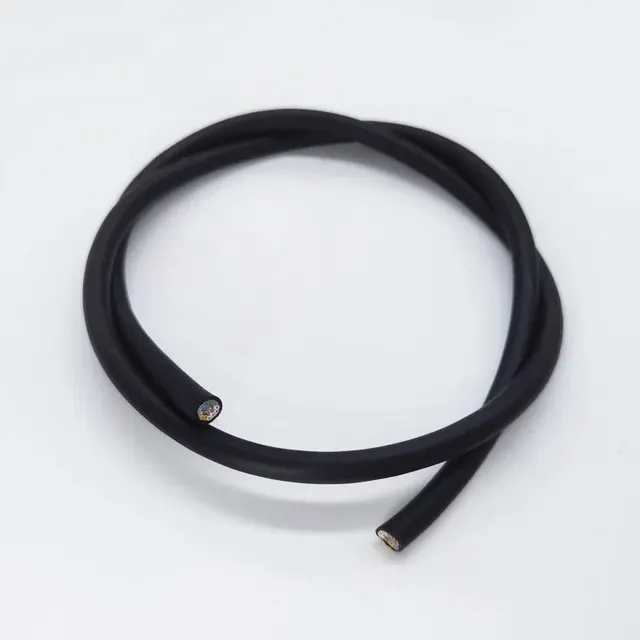
PDK91300-4×12AWG+2×20AWG Oil-Resistant Drag Chain Cable, NBR Sheath, OD 12.5 mm
Drag Chain Cables · Industrial Automation
PDK91300
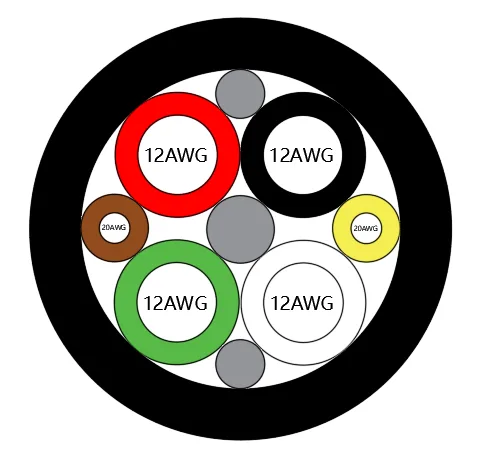
Drag chain cable with four 3.3 mm² power cores and two 0.5 mm² control cores, PVC insulation, NBR oil-resistant sheath, 450/750 V, OD 12.5 mm.
Product overview
Drag chain cable is a dedicated moving cable designed for continuous power and signal supply to machine parts that reciprocate, and it is widely used in machine tools, robots and automated production lines. The PAIDE PDK91300 series belongs to the drag chain and highly flexible moving cable category and uses a combined cabling layout of power cores and control cores, so one cable carries both the power supply and the control signal task. This reduces the number of cables laid in parallel inside the drag chain and makes wiring of the moving section simpler and later maintenance easier.
Model PDK91300-4×12AWG+2×20AWG consists of four power cores and two control cores and is positioned as an oil-resistant drag chain cable for CNC machine tool equipment. The product is manufactured and inspected to the technical conditions confirmed by both parties, and the sheath is printed in the standard way with the company identification, specification and model, production date and metre marking, so that the model can be identified and consumption counted on site. The sheath is black, and its voltage class covers the supply needs of most machine tool power and control circuits.
Construction and materials
All conductors are of bare copper stranded construction. The power core has a cross-section of 3.3 mm², stranded from 105 copper wires of 0.2 mm diameter, with a stranded diameter of about 2.36 mm; the control core has a cross-section of 0.5 mm², stranded from 28 copper wires of 0.15 mm diameter, with a stranded diameter of about 0.91 mm. Stranding many fine wires keeps the conductor flexible through repeated bending and reduces stress concentration in individual wires, which is the basis of the long bending life of a drag chain cable.
The insulation is PVC. The power core insulation has an average thickness of 0.67 mm with a minimum point of not less than 0.57 mm and an insulation diameter of about 3.7 mm; the control core insulation has an average thickness of 0.55 mm with a minimum point of not less than 0.46 mm and an insulation diameter of about 2.0 mm. Power core insulation is in four colours, red, black, white and green, and control core insulation in yellow and brown, so that different circuits are easy to distinguish when wiring.
During cabling, the gaps between cores are filled with PP rope so that the core stays round and compact and the cores press and rub against each other less while bending, which supports structural stability in long-term motion. This model has no shield of its own and is intended for conventional power and control circuits; where electromagnetic interference is a concern and immunity is required, shielded versions of the same series are available.
The outer sheath is NBR, black, with an average thickness of 1.5 mm, a minimum point of not less than 1.3 mm and a finished outer diameter of 12.5 ± 0.5 mm. NBR is nitrile rubber, which has good oil resistance and copes with the cutting fluid and lubricating oil mist found in machine tools; this is the main material basis for the model's positioning as an oil-resistant cable for CNC machine tool equipment. The print legend contains the company identification, specification and model, production date and metre marking by default.
Key characteristics
- Oil-resistant sheath: the NBR outer sheath withstands the oil media common in machine tools and suits long-term moving use in oily environments.
- Highly flexible construction: fine-wire stranded conductors with PP rope filling keep the cable soft and suitable for reciprocating bending in a drag chain.
- Bending performance: the minimum bending radius is 10 times the cable outer diameter, which can be used to allow bending space at installation.
- Temperature range: rated temperature -30 °C to +70 °C, covering normal workshop machining environments.
- Combined cores: power and control cores are cabled together, saving laying space inside the drag chain.
- Production basis: manufactured to the technical conditions confirmed by both parties; specific dimensions and performance are subject to the specification sheet.
- Standard printing: the sheath surface carries the company identification, specification and model and metre marking by default, which helps on-site management and consumption traceability.
Electrical performance
The rated voltage of this model is 450/750 V. Maximum DC conductor resistance at 20 °C: 5.6 Ω/km for the power cores and 37.4 Ω/km for the control cores. The larger power core cross-section keeps circuit losses relatively low, while the control cores meet the normal requirements of signal and switching transmission. These DC resistance values can be used as a reference when calculating line voltage drop; actual current rating and permissible installation length need to be assessed together with the operating environment, bending frequency and other factors.
Typical applications
The cable is suitable for the drag chain systems of CNC machine tools, machining centres and automation equipment, supplying the power and control circuits that move with the worktable, robot arm and other moving parts. Because the sheath is oil resistant, it also works long-term in machining environments with cutting fluid splash and lubricating oil mist, and it suits other industrial equipment that needs flexible moving wiring. When installed in a drag chain, the cable should not be subjected to excessive torsion and sufficient bending space should be allowed in line with the minimum bending radius to safeguard service life. For equipment with fast movements or long travel, we recommend confirming the bending frequency capability against the actual working conditions, checking the sheath condition inside the drag chain at intervals, and removing metal chips and debris that enter the chain in good time so that foreign objects do not wear the sheath and affect long-term reliability.
Customisation and selection notes
The PDK91300 series also offers other combined layouts. One example is a higher core count construction with three 10AWG power cores plus one power core of the same size class as this model and a pair of 18AWG twisted control cores; its rated voltage is the same as this model, its rated temperature is -35 °C to +105 °C and its minimum bending radius is 15 times the cable outer diameter. Another example is a 4×1.0 mm² version with tinned copper braid shield, rated 300/500 V, with the same rated temperature as this model and a minimum bending radius of 8 to 10 times the outer diameter, the shield suiting circuits with signal immunity requirements. Core count, cross-section, sheath colour and print legend within the series can all be adjusted to project needs; for combinations not listed, please contact PAIDE so that final technical parameters can be confirmed in a specification sheet. The core count and cross-section in the model designation can be used directly as the basis for discussion; PAIDE can recommend a suitable construction for the operating environment and confirm the complete performance documents with the user before volume supply.
Related in Drag Chain Cables
Engineering enquiry